I recently came across a piece of research that made me think again about something we talk about frequently in healthcare: data.
Not simply how much data we collect, but whether we are collecting the right information, connecting it appropriately and, importantly, using it to improve people’s health.
Researchers from the University of Oxford and Oxfordshire County Council have analysed routinely collected adult social care records from 27,590 people in Oxfordshire. Their study, published in npj Health Systems, looked at whether this information could help anticipate future care needs, hospital admission and mortality.
The results are interesting. The researchers found that routinely collected social care data could provide meaningful predictive information about hospitalisation and mortality. They also found evidence that changes in people’s care needs can sometimes emerge before more obvious clinical deterioration.
That is important.
Healthcare data has traditionally been dominated by what happens within healthcare: diagnoses, prescriptions, appointments, test results and hospital admissions. Yet our health is influenced by much more than our interactions with clinical services.
Information about mobility, independence, occupational therapy, reablement, care needs and the support someone receives can add another dimension to our understanding of their health.
It made me think about a conversation I had recently with @Jon Sparkes OBE, Chief Executive of Mencap.
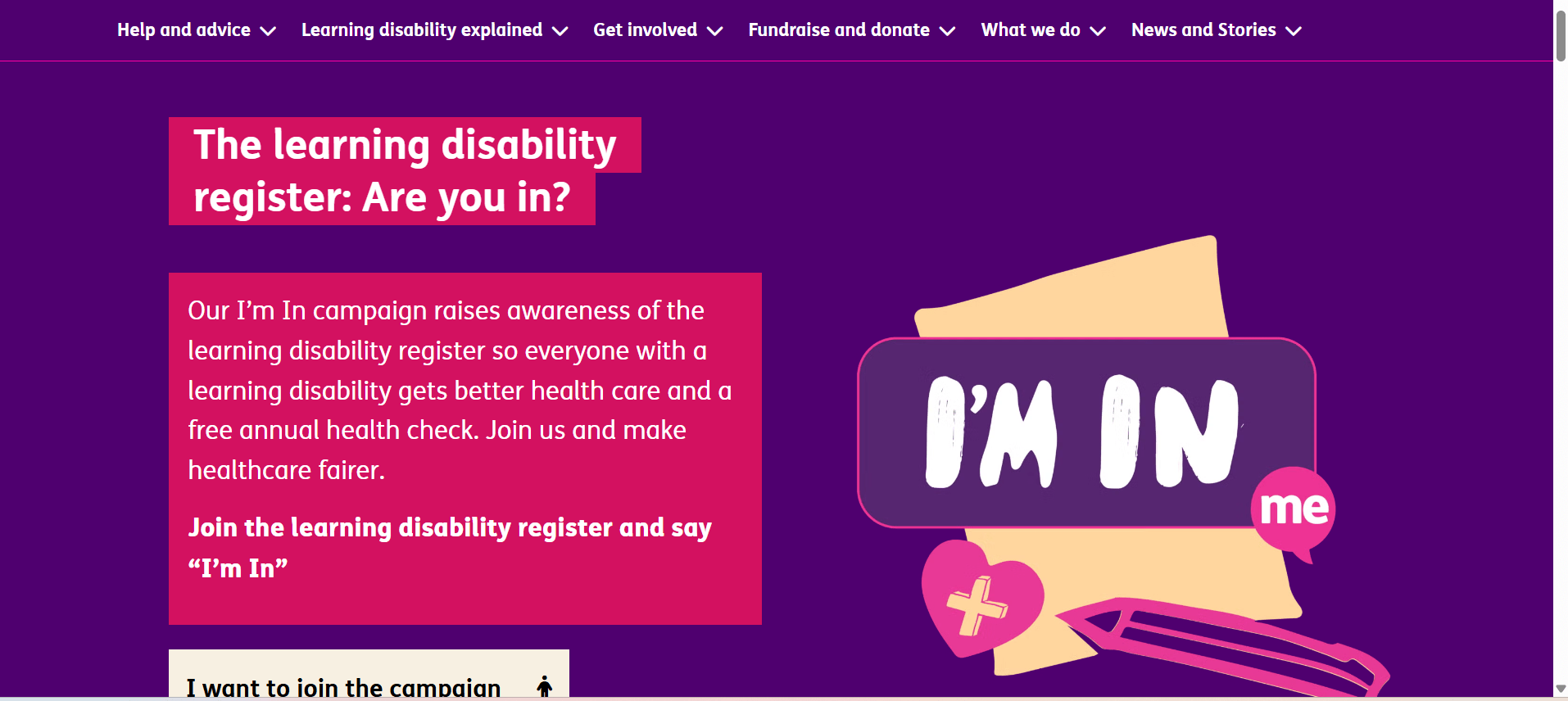
Mencap is currently running its I’m In campaign, encouraging people with a learning disability to make sure they are included on their GP’s learning disability register.
This might sound like a relatively simple administrative matter. It isn’t.
Being on the learning disability register can help GP practices identify people’s needs and ensure they receive appropriate support, including access to an annual health check and reasonable adjustments.
There is a significant need for this.
People with a learning disability experience poorer physical and mental health and considerable health inequalities compared with people without a learning disability. Government guidance recognises these inequalities, while Mencap’s analysis suggests that around three quarters of people with a learning disability are currently missing from GP learning disability registers.
If the health system does not know that someone has a learning disability, an important piece of information is absent.
And that raises a much bigger question.
What could we understand if we were better at bringing together the information we already collect across health and social care?
A learning disability register is one example. Social care records are another. There are also primary care records, hospital data, community services, mental health services and information about people’s changing support needs.
Viewed independently, each tells part of the story.
Used appropriately together, they could potentially tell us much more.
The Oxfordshire research is particularly interesting because it suggests that non-clinical information may provide signals before clinical deterioration becomes apparent. Rather than waiting for someone to become unwell enough to require hospital treatment, could integrated data help identify where earlier intervention is needed?
That changes the conversation from treating illness to anticipating need.
For people with learning disabilities, this could be particularly important. We already know this population experiences significant health inequalities and a higher risk of avoidable ill health and premature death.
Better identification is therefore not simply about improving the completeness of a database.
It creates an opportunity to plan.
To offer appropriate health checks. To make reasonable adjustments. To recognise changing needs. To identify patterns across populations. And potentially to intervene earlier.
Of course, bringing datasets together requires careful governance, clear purpose, transparency and appropriate safeguards. More data does not automatically produce better care, and predictive models should support rather than replace professional judgement.
The Oxfordshire researchers themselves recognise this. Their work is not presented as an automated clinical decision-making system. Further validation, evaluation, consideration of equity and integration into real-world workflows would all be needed.
But the direction of travel is important.
We have spent years building separate pools of information across health and social care. Increasingly, the opportunity lies in understanding what those datasets can tell us collectively.
The value of data is not in collecting it.
Its value comes when we can use it responsibly to understand people better, anticipate need, reduce inequalities and provide care earlier.
For me, Mencap’s campaign and this new research illustrate two sides of the same issue.
First, we need to make sure people are visible within the data.
Then we need to become much better at using that information to make them visible within the decisions we make about healthcare.